Demo operations
Demo Calendar Availability Analysis
A reconstruction of public HubSpot demo availability from 23 snapshots captured June 27 through July 7, 2026, testing whether calendar supply is what caps Ambiki's growth.
Executive summary
Demo capacity exceeded observed demand. Across nine elapsed appointment days, roughly 19 of 67 independent 45-minute openings (~28%) remained unbooked at the final capture before the appointment date. The constraint is not slots; it is consistent qualified demand and efficient calendar management.
Day-by-day results
Only July 3, July 7, and July 8 cleared completely. Six of nine days carried unused availability; July 10 leaked the most.
| Appointment date | Unbooked start options | Approx. independent 45-min openings |
|---|---|---|
| June 29 | 4 | 2 |
| July 1 | 6 | 2 |
| July 2 | 9 | 3 |
| July 3 | 0 | 0 |
| July 6 | 1 | 1 |
| July 7 | 0 | 0 |
| July 8 | 0 | 0 |
| July 9 | 8 | 4 |
| July 10 | 20 | 7 |
| Total | 48 | 19 |
The calendar offered 45-minute meetings at 15-minute start intervals, so the 48 raw start options are heavily overlapping and do not represent 48 meetings. Converting the remaining options into the maximum number of non-overlapping 45-minute periods gives the more useful estimate of 19 unbooked openings.
Approx. independent 45-minute openings left unbooked, by appointment date
July 10's estimate is the least reliable: tracking stopped July 7, so those seven openings could have booked after the final capture.
What the data suggests
Six sub-findings point away from a capacity problem and toward demand quality and calendar design.
Availability is not constraining pipeline.
Prospects generally had abundant access to demo times. The calendar rarely presented a scheduling bottleneck, so there is little evidence that insufficient availability was suppressing pipeline or preventing interested buyers from booking.
Demand is uneven and does not reliably fill the calendar.
Three days cleared, but six retained availability. The sharp variation, particularly the seven estimated unused openings on July 10, suggests inconsistent demand rather than a calendar operating near capacity.
The public calendar may expose too much inventory.
Offering starts every 15 minutes creates dozens of apparent choices while providing far fewer independent meeting periods. This exaggerates the visible supply, can weaken perceived scarcity, and makes the sales calendar look less active than a deliberately packaged set of demo times would.
The calendar likely fragments the rep's workday.
Exposing start times across much of the day makes it difficult to protect focused selling, follow-up, and pipeline-development time. Even if only a handful of meetings book, the possibility of a meeting beginning every 15 minutes keeps large portions of the day operationally constrained.
Some calendar consumption appears close to the meeting date.
Availability frequently disappeared between successive captures. That is directionally consistent with prospects booking relatively close to the appointment date, although the public calendar cannot distinguish a genuine booking from time manually blocked by the rep.
More demo capacity is not the immediate need.
The available evidence does not support expanding demo capacity. The more valuable commercial questions concern how Ambiki generates additional qualified demand, how quickly leads book, and how effectively completed demos become opportunities and customers.
The same conclusion emerged from the Secret-Shop & GTM Analysis: the constraint is conversion and orchestration, not capacity. Growth is capped by demand quality and the managed path from demo to activation, not by an inability to take more demos.
The buyer's inbox, before and after the demo
Seven captured emails show Ambiki's polished pre-demo automation and Fusion's stronger seller-led post-demo motion. Select any date or use the arrows to flip through the sequence.
Jun 18 · 14 days before Ambiki demo
Meeting booked
Immediate transactional notice from Charlotte with the July 2 date and Zoom location.
Fast confirmation, but the buyer-facing value is purely logistical.
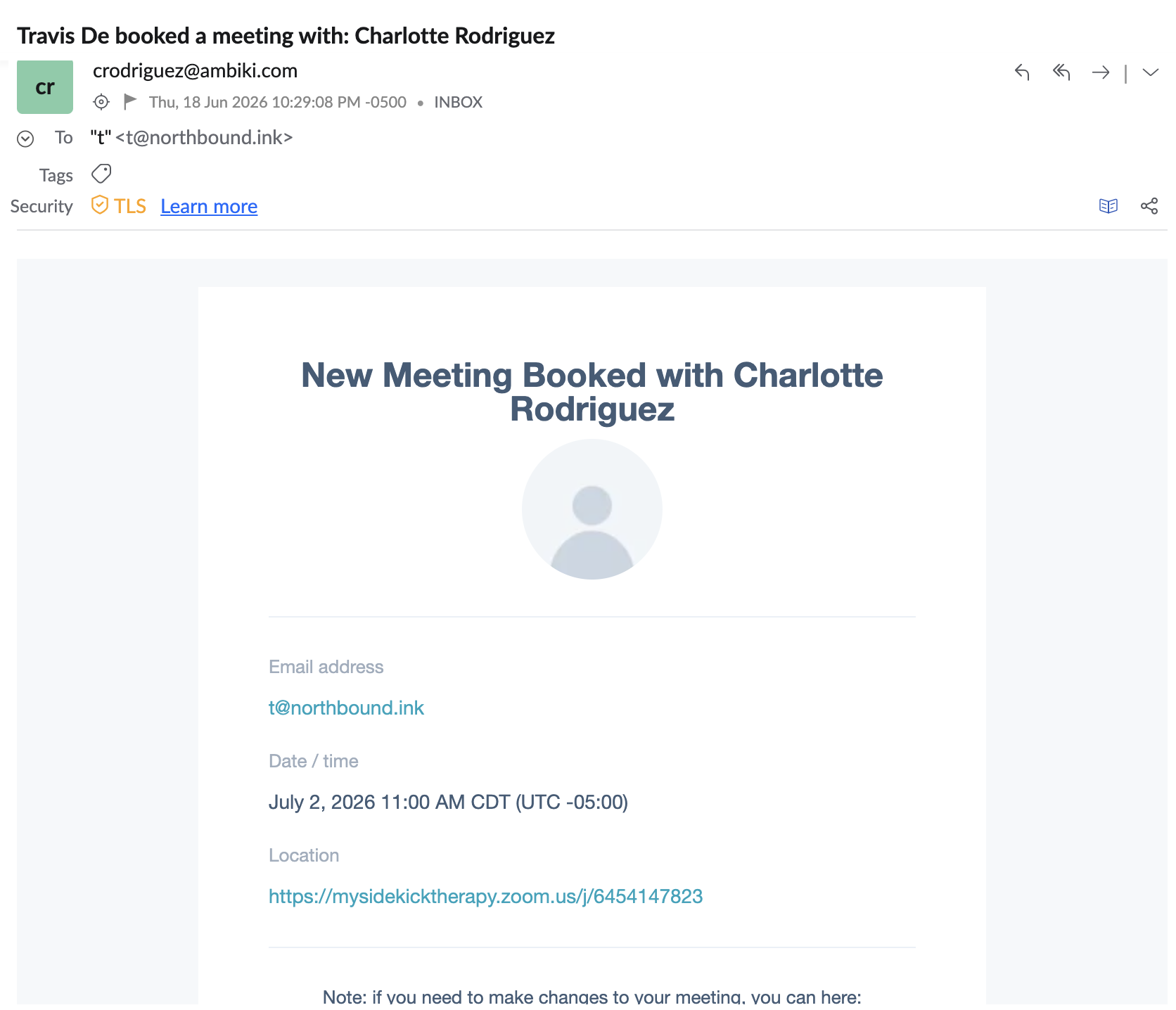 Open full capture ↗
Observed Ambiki gap · as of July 13
The sequence stops when buyer intent is highest.
Ambiki sent an automated meeting recap and one generic billing nurture, but no further marketing or seller communication was received in the 11 days after the July 2 demo. There was no tailored recap from the rep, worked quote, competitor comparison, proof matched to the buyer, mutual action plan or scheduled follow-up. Fusion's same-day email delivered nearly all of those elements and committed to reconnect the week of July 27.
Turn captured intent into a tailored brief
Use the booking form's actual answers in seller outreach: mirror the stated billing, authorization, telehealth and onboarding needs, then preview exactly how the demo will address them.
Make the recap commercial, not merely automatic
Send a rep-owned recap within hours with priorities, decisions, open questions, recording, itemized pricing and a recommendation. The automated transcript can draft it; the seller should own it.
Build a 14-day post-demo path
Orchestrate useful touches on days 1, 3, 7 and 14: quote and recap, relevant switch proof, objection handling, then a direct close-the-loop note. Pause generic nurture while the deal is active.
Never end without a dated next step
Agree on the next meeting before the demo ends and restate it in the recap. If the buyer is not ready, set a specific decision checkpoint tied to their implementation deadline.
Recommended calendar design
- Offer demos on a cleaner cadence, such as hourly starts, rather than every 15 minutes.
- Concentrate demos into defined blocks to protect prospecting, follow-up, and focused work.
- Preserve a limited number of near-term openings for high-intent prospects.
- Avoid manufacturing excessive scarcity; the goal is to package availability clearly and efficiently.
- Track actual booked meetings, completed demos, no-shows, qualified opportunities, and revenue, not merely disappearing public start options.
→ The full measurement architecture: KPI & Forecast Model
Measurement limitations
- This analysis is directional rather than a definitive utilization audit.
- The sample covers only nine elapsed appointment days.
- Tracking stopped July 7, making the July 9 and July 10 estimates less reliable because those slots could have booked after the final capture.
- A disappearing option may represent a booking, a manual calendar block, or one meeting eliminating several overlapping start times.
- A slot that remained open at the final pre-date capture could still have booked afterward, making the unbooked estimate an upper bound.
- The existing
missed_opportunity_slotsfield reports zero throughout and does not capture the day-level expired availability calculated from the raw snapshots. - The public availability data does not reveal completed meetings, cancellations, no-shows, qualification, opportunity creation, or closed revenue.
Bottom line
Ambiki's demo calendar appears to have more supply than observed demand requires. Buyers can access demos readily, but the broad availability creates excess visible inventory and likely fragments the rep's time. The stronger move is to package the existing capacity more deliberately while improving qualified demand generation and measuring the full demo-to-revenue funnel.
The commercial read
Demo supply is plentiful; consistent qualified demand and efficient calendar management are the constraints. The next investment is not more slots; it is more qualified demand, faster booking, and a measured path from demo to opportunity to revenue.
Sources
scheduling-analysis/charlotte-rodriguez/README.md · scheduling-analysis/charlotte-rodriguez/daily-summary.csv · scheduling-analysis/charlotte-rodriguez/snapshots/ · scheduling-analysis/charlotte-rodriguez/reports/ · secret-shopping/email captures/